Showing posts with label adventure. Show all posts

16 July 2012

Peak of Energy

Untitled, Art Journal Page by ~runningwave~ 2012
Art Journal Page by ~runningwave~

“And so with the sunshine and the great bursts of leaves growing on the trees, just as things grow in fast movies, I had that familiar conviction that life was beginning over again with the summer.” 


Summer in the Chesapeake region is hot and hazy. Particularly this summer, since we had that incredible triple-digit heat wave at the end of June through the beginning of July.

Summer is also heady -- exciting, intoxicating, a peak of energy and activity.
Days are extra long, so the increased daylight seems to make everyone squeeze out every minute with being active, especially outdoors.

My world is moving on a giant burst of energy this summer, "just as things grow fast in the movies," like F. Scott Fitzgerald wrote.  I'm in the center of a whirlwind of activity, largely self-propelled.

And I'm happy about it.

I've found that I am now creating the space in my life to be creative -- in diverse ways.

I'm giving myself permission to make time for my creativity without feeling guilty, as though I should be doing something else for the benefit of others.  I've observed in the past few weeks that when I'm at my creative peak, I'm also able to think more clearly. The creative energy I give off is useful to others. People learn from me, just as I'm learning from them. People complement my artwork that I have enjoyed spending time making.

Give and take -- not really a selfish act to express yourself. I wouldn't call the great artists I've known and learned about -- visual artists, musicians, actors -- selfish for practicing with their talent. I think they are doing what the love and hoping other people can enjoy it too.

I've begun to think of myself as an artist, who happens to have a day job doing something else. This is a recent change in perspective for me. I spent many years working hard to build a career until I found a job in which I make a professional wage that rather enjoy doing. Yet, I've also had to stop and consider where my heart is.

I am no longer struggling to make ends meet like I did in long years of graduate school. Nor am I doggedly competing to find a job that I enjoy that both pays the bills and suits my talents and temperament. I've found it, so I had to ask myself "Just why, why am I not satisfied?"


My heart answers, that I did put one thing aside when I decided to move forward in a career that brought me along the path I now tread. A - R - T


I attended an art school for two years, studying  commercial photography way back when. When I reached my graduation, I wasn't all that pleased about my job prospects. In the Midwestern town where I got my degree being a woman photographer in a commercial studio was not a glamorous job unless you made it to the top of the heap. Otherwise, you'd be making the coffee for other photographers and doing the hauling of lighting equipment, until your talent got noticed. If it got noticed at all.


So, I left my art behind in pursuit of more rigorous intellectual training, which I also loved. I always thought I was glad to have been to art school, but equally glad I was not a starving artist.

Well, I certainly have my basic needs met as I sit here today. I want more, and I'm taking this seriously at last.

Not giving up my day job any time soon, but when I have the free time, you'll find me taking art classes and working in new media. Practicing and stretching my very, flabby artistic muscles.

Not sure yet, where this path is taking me, but I am exhilarated.

I feel a sense of wonder and the thrilling taste of  adventure.


14 August 2008

Like Wildfire

If it’s taken me a while to document my June trip to California, it is because I wanted the time and space to ponder this most unusual trip to a countryside normally so familiar. This most recent trip to California was like a journey to another country, an unfamiliar territory so altered is the entire state by the element of Fire.


DAY 1
My husband M and I define a typical week of vacation as time spent doing as much outdoors as we can possibly squeeze into ten days. We flew across the United States sardine between two rows of young children, one of which wailed almost the entire way. I had not slept well for several nights before the flight so needless to say the screaming child lungs made my brain want to dissolve. Plus, I was starving. I had been too tired to remember that gone are the days when meals are provided in-flight. Not even a lousy bag of peanuts anymore. Hah-rumph!

Descending into LAX we discovered a heat wave. Los Angeles was not on fire, but it felt like it at 107-degrees Fahrenheit M drove North into the arid San Joaquin Valley and I blissfully slept through the afternoon, California dreamin’.

When I awoke we were nearing the mid-sized town of Tulare and we stopped to grab a take-out sub for dinner. The radiant heat from the parking lot tarmac was nearly unbearable. But, I thought, It’s a dry heat. (Unlike the semi-tropical Maryland swamp from where I had just come.)

DAY 2
We woke up before the sun rose, still on East Coast time. We were happy to have the early start so that we could walk among the Giant Sequoias in relative peace and quiet before the tour buses arrived. The National Park was some distance from Tulare, so we drove through some of the smaller towns and out into the “salad bowl” region at their outskirts. I saw vast rows of vegetables, soaking up the solar glare, ripening for the mega-market grocers so that they might make it onto American’s dinner plates. Some nice bits of nostalgic Americana can be viewed as you near the park, like the ten-foot high, metal Steer-shaped roaster at a B-B-Q stand.

Soon the road began to wind out of the valley and into the rolling lowlands of the Sierra Nevada Mountains. We were amazed just how much winding we were doing. It didn’t look so winding on the highway map. The vistas of foothill lakes and green hillsides were worth the twisting drive.

We entered Sequoia National Park at the crest of the Sierra. I’d seen photographs of the Sequoias since childhood, but none of the images could prepare you for standing at the foot of a tree that could be one of the oldest living beings on the plant. Walking in a grove of Sequoias might make you believe in J.R.R. Tolkein’s race of Ents or believe in tree spirits. They are so tall and so old; they embody the meaning of word “great” in every way.


For me this experience of touching the Sequoias’ greatness was awe-inspiring. What made the trip all the more poignant was that after we returned back down to the broiling Central Valley we found out on the TV news that 800 fires had been sparked throughout California . Many wildfires resulted from these first sparks, caused by the combination of a land already desperate with drought hit by a rash of dry thunder and lightning storms.

At the time I was watching the news in my safe hotel room, the concept of wildfires seemed somewhat distant. But little did I know that I would be learning more than I ever cared to about the threat of wildfire in California before the end of this vacation.

29 August 2007

Make Sail


Last Sunday evening I did something that I had only dreamed about in the past.

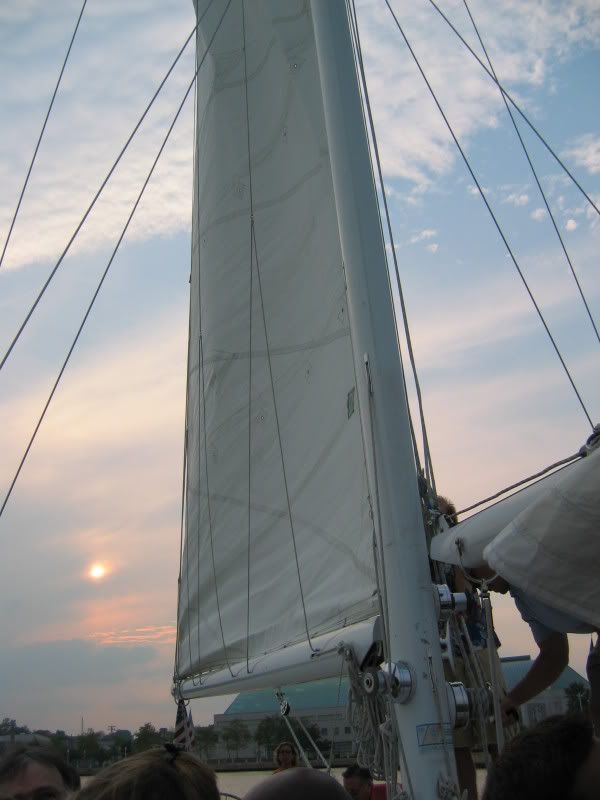
I cruised on a sailboat and, for a brief few minutes, actually had the opportunity to steer. We were cruising on Schooner Woodwind II on the Chesapeake Bay, approaching the mouth of the Severn River near Annapolis Harbor. I had to use the dome of the State House as my point of reference for keeping the sails steady as she goes.

Under the easy wind conditions and light of remaining dusk, the schooner was not harder to steer than driving a car. It isn't like the tall ships of old, in that it does have a motor and it also has modern steering and components. For a few brief moments, however, I might have been sailing a fishing ship into that well-known harbor at the edge of the Chesapeake Bay.

I asked the Captain, Jen, a very gregarious lady to be sure, if a person had to grow up around sailboats to learn how to sail. "No!" said she. And she even gave me the name of a local sailing school and told me about an Annapolis-based sailing club where you share ownership in a sailboat so that you can take your turn cruising, even if you don't own your own ship. Wow!

I grew up near several large rivers, but in a very landlocked part of south-western Ohio and northern Kentucky. To be behind the wheel of a boat, any boat, is a dream come true. I always dreamed of sailing and sailboats. I think that's what lured me to Annapolis. But I was always too timid to ask people if I could go out on their boats. I supposed that I figured someday my chance would come. Well, thanks to my very generous husband who liked the idea of a Thai Dinner cruise on the Bay, I finally had my wish.

Sailing was even better than kayaking!!!! I just love being out on the water.


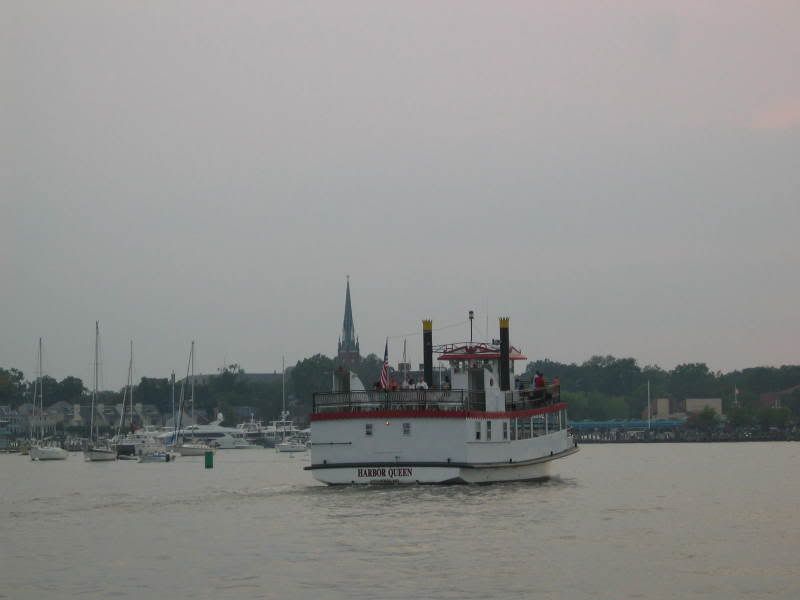
Here's a link to a photo of our vessel returning to Annapolis Harbor at twilight behind the Harbor Queen. See the Church steeple in the background? That's St. Mary's Cathedral.

19 August 2007

Harlaxton College Remembered

It doesn't seem at all like 20 years have past since my freshman year of college. On this date in 1987 I was packing my two allotted suitcases and bursting with anticipation of spending my freshman year abroad in England.

I had grown up in a small town in Northern Kentucky near Cincinnati, Ohio and I never fit in with 98% of my high school classmates. My 11th grade guidance counselor looked at me as though I sprouted horns when I clearly stated my intention of studying in England for my first year in college. "You mean, you don't want to go to UK [Univ. of Kentucky]?" he asked incredulously. A large percentage of my college-bound classmates were headed there. I was furious with him, but then I was furious and impatient with people in general in those days. So I embarked upon my own mission to find a college program where a freshman could study abroad. My mother and the Cincinnati Public Library's resources helped me in my quest. From the library I found an address for the Council on International Education Exchange. They sent me a 3/4" catalogue of study abroad programs. I narrowed it down to three programs that permitted freshman to enter their program, but one of the three leaped out at me from the page and said something like this:

Study in a stately home built in the 1830s by industrialist Gregory Gregory. Take liberal arts classes taught by British and American faculty in state rooms and live on a manor with 6.5 acre walled garden and formal gardens. . .

When I applied to the University of Evansville for admission to Harlaxton College all those years ago, I had no idea how much it would change my life. For the first time I felt like the world was huge and mine for exploration. I found my profession, art history, there influenced by one of Harlaxton's eminent faculty members, medieval scholar Lady Wedgwood [Dr. Pamela Tudor-Craig]. Even though my parents are professional artists, I had no idea that you could think, talk and write about art as a job before attending Harlaxton and sitting-in on Lady Wedgwood's amazing lectures. I also took four courses in British history and literature, and a wonderful science course on Physical Geography of Great Britain. I absorbed quietly like a little sponge and adored every minute of starring up to a ceiling of gilt Victorian grandeur or stone masonry.

And I traveled. Every weekend I went somewhere, all around the island of Great Britain, including North Wales, Edinburgh, York, Lincoln, the Cotswolds, the Lake District, and of course, many trips to London. Each semester were had two four-day long weekends for travel and so I went to the Ile de France, to Venice, to Rome, and explored the seaside town of Ramsgate where my great grandmother Anne left behind those shores for the New World.

I met some wonderful people art Harlaxton and found myself immersed in diverse cultures. It was truly an international community with students from the UK, Europe, the Middle East all blended together. I went to pubs and imbibed good British cider and bitter. I ate Indian food for the first time. I became friends with students from Chicago, rural Indiana, and Germany. I'll never forget the evening that the Turkish students invited us to share strong coffee and Turkish delight with them. I won't for get the fall evening of the Guy Fawkes Night Bonfire and an evening ramble to explore Harlaxton's creepy gatehouse. My friend AC and I explored the punk clothing stores in Nottingham and played Warhammer role-playing games in the evenings. The American students put together a haunted house for Halloween and a one-mile line of British teens were lined up to go inside (back then, haunted houses were an oddity in England). We rented costumes and enjoyed a fabulous masquerade ball in the great hall each semester.

It would be impossible for me to encompass that entire year into one short essay and do it justice, but I can only hint at the richness I learned by seeing, touching, hearing about things that were far older than any European settlement in the United States. I had such a hunger for anything antique or ancient. The tangible contact with all that history changed me. It grounded my future and raised my awareness to things beyond the tiny, provincial community where I had lived most of my then 18 years.

Now sitting here twenty years later it is difficult for me to separate the strands of my life that were affected by this grand tour experiment of mine in my freshman year. I would be a different person now, if not for Harlaxton. I would venture to guess I am a more interesting and better education person for having been there, too.

22 February 2006

Life in the Jungle

Two photos by Runningwave from her vacation in Costa Rica, February 2006.


From: Webster.com

Main Entry: jun·gle

Pronunciation: 'j&[ng]-g&l

Function: noun

Usage: often attributive

Etymology: Hindi jangal forest, from Sanskrit jangala desert region

1 a : an impenetrable thicket or tangled mass of tropical vegetation b : a tract overgrown with thickets or masses of vegetation
2 : a hobo camp
3 a (1) : a confused or disordered mass of objects : JUMBLE (2) : something that baffles or frustrates by its tangled or complex character : MAZE b : a place of ruthless struggle for survival


Jungle is a word that has very specific connotations to people who grew up in the Western countries of North America and Europe. Jungle is often something "other" to the world we use to describe our orderly, clockwork society: civilization. I find it interesting that Webster's Dictionary list the etymology of the word from Hindu simply meaning "forest." For indeed when I encountered "the jungle" for the first time twelve days ago in Costa Rica, I found it to be simply that: a forest. A tropical rain forest to be precise, yes, but "the jungle" doesn't look all that different up close as some of the forests of my home country. Different and more diverse plants, certainly. Animals of every size and description that were new to me, absolutely. But I wonder if monkeys howling or barking in the trees seem as wild to a Costa Rican native as it did to me? (See the photos of Capuchin and Howler Monkeys I took on the trip above.) Afteall, I have actually seen tourists oo-and-aaah at and then photograph deer in National Parks in the U.S., where I don't view deer as "wildlife" any more since they are so common in Maryland suburbs like squirrels or raccoons.

So the jungle is a bit less mystifying for me now than it once was. In my childhood, I love reading stories about jungles in India and other parts of southeast Asia and in the Americas. I enjoyed Rudyard Kipling's tales and dreamed of becoming an intrepid explorer. One of my favorite stories in English class was Richard Connell's "The Most Dangerous Game," about a big game hunter who becomes the hunted. I reveled in film versions of H. Rider Haggard novels like She and King Solomon's Mines and cinematic and literary images of Sir Arthur Conan Doyle's Lost World.

While on my vacation to the rain forests of Costa Rica, I took along a wonderful book entitled Latitude Zero: Tales of the Equator by Gianni Guadalupi. The book divides the narratives of equatorial exploration and conquest by "temperate zone" Westerners by continent and relates the successful and disastrous adventures of explorers from the 15th century through to the Victorians and Edwardians. This reading helped me to frame my own travel with the fantasies I have always had about exploring the unknown. I found myself intrigued and amazed by what the explorers encountered and saddened by the terrible costs in human life and in deforestation that often occurred while these places were forcibly opened to the West.

Yet there is something cathartic about separating the childhood dreams and dark illusions of youth from the real, living and breathing tropics. For me, the treks we made into the jungle opened my mind to the tremendous fertility of the planet, if only we will preserve what's left of these wild spaces. Spending ten days fording rivers; powerboating down canals; elevating ourselves into the forest canopy on a sling; whitewater rafting; and hiking in different microclimates brought us to places where we could encounter all sorts of animals that I found exciting and unusual: from macaws, to lizards, to orb weaver spiders, to troops of coatis (rain forest raccoons), to an anteater, to sloths and to monkeys.

We were able to fly over mountains in small planes to get from the capital of San Jose to the isolated National Parks on the Pacific and Caribbeann coasts and to drive through the mountainous central areas of this tiny tropical nation. Small it may be in land mass but, oh, how much of the wilderness is left in this beautiful country since some Costa Ricans had the foresight to protect what natural resources remain beginning in the 1970s.

I am still not a great fan of the combination of heat and humidity impacting on climate (cool, dry weather for me, when I can get it!), but I am so glad I bore the weather to take this trip, opening up a whole new world for me. I don't think I will ever understand the word jungle in quite the same way.

08 February 2006

Into the Unknown: Risk and Creativity

This week’s post is dedicated to Explorers. Explorers are people who willingly go into the unknown to face whatever the Universe sends them.

As a historian by training, I have had many opportunities to ponder what it would be like to travel into the unknown. Some explorers travel into the unknown on a physical level. The great sailors of the eighteenth-century were such men and women. They had already mapped much of the globe, but did not have the technology to predict storms weeks in advance nor did they know how animals or indigenous peoples would react to their arrival on distant shores. In that world intrepid men like Captain Cook did not always make it home alive.

Other explorers travel into the unknown on a mental plane. I am thinking this time of scholars, scientists and artists, who use their imagination to take them to breakthroughs in their understanding of their field. Those who know me well, know that I spent years researching the experiments of modern artists and designers who found beauty in abstract art of the past and of other cultures and adapted it for their own purposes. I am recalling the image of the 1905 Autumn Salon in France when the Fauves first unleashed their wild colors and violent brushstrokes on an unprepared public. Now I walk down the street of any major city in the U.S.A. or Europe and could see a Fauvist poster hanging in a shop or cafĂ© and think it unremarkable. But the Fauves caused riots in their day because they broke the boundaries of convention and leaped into a style that transgressed what that culture believed to be “normal.” What a difference one hundred years makes!

Of course, there is another level of journeying into the unknown. It is one that I have been introduced to over the years, but not a type of journeying that I find easy or comfortable yet. I refer to spiritual exploration, where a traveler journeys inward to a place beyond the physical and mental planes to a place that is exists only in the present. I am learning Yoga practice again after a thirty-year lapse from my introduction to it as a young child. My life is very busy and I often feel so over-stimulated by thoughts, sights and sounds of the modern world that I find meditation very difficult. I find slowing down difficult. It may take me many years to become comfortable with journeying inward into transcendence and, perhaps, I will never achieve being fully in the present, but I continue to learn about what others have done in their spiritual practices to find that place.

All three types of encountering the unknown that I have mentioned: physical, mental and spiritual, involve one key factor—risk. And risk is the point at which you decide if your creativity will help you to survive. I think that a healthy person needs some element of risk in her or his life, in order to maintain their “creative muscles,” just as athletes need to use their muscles or fail to improve their skills.

My husband and I are leaving this week to travel by plane to the Central American country of Costa Rica. A professional outfitter with an international reputation and bilingual guides will be taking us to several of the national parks across the country. Costa Rica touches both the Atlantic and Pacific Oceans and features diverse wildlife and many different ecosystems and climate zones. I am trying very hard not to create expectations in my mind of what I will encounter. I want very much to just “be” for a brief time and make this a real retreat from modern life as I know it and learn from the Costa Rican people some new ways of living and existing. I find myself unable to fully suppress the excitement of observing wildlife, but realize that a lot of the very fascinating mammals I would love to see will probably be out avoiding humans by day and lurking in the shadows at nighttime. I also admit to being intimidated by the idea of hiking through the rain forest with 90° F heat and 90% humidity. My mind wanders when I think of the many stories about the jungle I read as a child (and as an adult!). So I am returning to my yoga training and studiously calling my breath and finding balance.

On my expedition into the unknown I hope to find out what shape my creative muscles are in. Would I have had the courage to travel with a physical adventurer like Captain Cook and explore distant lands? Will I observe something in the culture of the people of this land that I could inspire me to adapt my life at home? And will I attain the calm in the center of the fugue of modern life and be able to fully distance myself from all that I leave behind.

Perhaps I will have answers the next time I post to this blog.

I hope if you have read this entry, you will share in the comments something about your own explorations on any level of your life.